Practice › Pickleball
Pickleball Solo Practice With a Live Form Coach
Pickleball is a game of soft hands and small habits: a compact swing, contact out in front, staying low. You can train all of it alone. Prop your phone up, practise the shot, and Formanti checks each swing and says what to fix.
The pose tracking runs on your phone and your video is not uploaded. Choose a shot below to see what is checked, and the drills it gives you for what you keep missing.
No equipment needed. Practise at home. Just do the swing properly in front of your phone. No court, ball or shuttle is needed, and a racket is optional: the coach judges your movement, so a shadow swing at home in a hallway or garden is enough.
What you get after a session
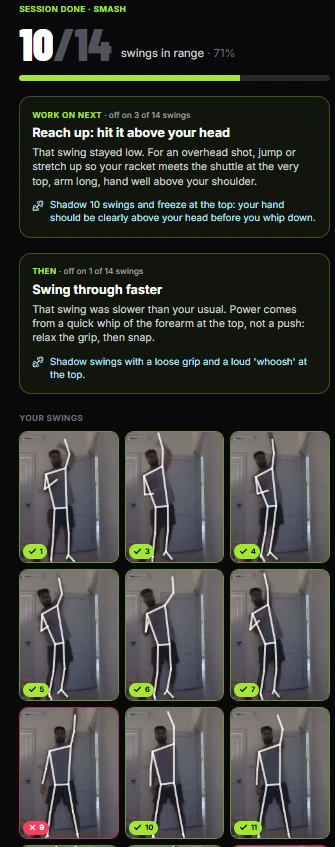
When you finish, you get a report like this one.
- How many swings were in range, out of how many.
- The one thing to work on next, then the next, each with a drill.
- Every swing as a picture with your skeleton on it: ticked, or flagged with what was off.
How to practise pickleball on your own
- Stand 2 to 3 metres from your phone, whole body in view, side-on to your paddle arm if you can.
- Take one shot at a time, 15 to 20 swings, and keep the swing small.
- Bend your knees: most pickleball shots are hit low, and the legs do the work.
- Check the report for the one habit that repeated, then take it to a wall or the court.
What to work on first
Stay low and keep it small. Most missed dinks and drops come from standing up and swinging big. Bend your knees, keep the paddle out in front and hit with a compact motion. Then add the serve: a legal, deep, repeatable one is worth more than a hard one.
Pickleball shots you can practise
- Dink: Softer pickleball dinks: knees bent, contact in front, a short compact swing.
- Drive: Flat, low pickleball drives: contact in front, turn the body, drive through.
- Volley: Quicker pickleball volleys at the kitchen line: paddle up, short punch, hit in front.
- Serve: A reliable, legal pickleball serve: underhand, below the waist, deep.
- Third shot drop: A better pickleball third shot drop: low to high, soft, landing in the kitchen.
Frequently asked questions
How do I practise pickleball by myself?
Shadow swings for the technique, a wall for contact, and a bucket of balls for the serve. A phone watching your form turns the shadow work into proper practice.
Does it work for dinking?
Yes. It looks at where your paddle meets the ball height-wise, whether you are reaching out in front, and how big your backswing is, which are the three things that make or break a dink.