Squash volley: check your form with your phone
The volley takes the ball before it bounces, giving your opponent less time to recover. It is a compact stroke, played with the racket up and a short swing.
No equipment needed. Practise at home. Just do the swing properly in front of your phone. No court, ball or shuttle is needed, and a racket is optional: the coach judges your movement, so a shadow swing at home in a hallway or garden is enough.
What good looks like
- Keep the racket up and out in front in your ready position.
- Use a short swing and step toward the ball, hitting it in front of you.
- Take it early so the opponent has less time.
- Return to the T straight away.
Common mistakes and how to fix them
A big swing
A big swing is too slow. Keep it short.
Taking the ball late
Volleys work because they are early. Step in and meet the ball.
Dropping the racket
Keep the racket up so you are always ready.
What Formanti checks on your volley
At the moment of contact, on every swing you take.
- Contact in front: hand clearly in front of your shoulder. meet it in front of you, not beside or behind
- Contact height: about chest to waist height. the height this shot is usually hit at
- Backswing: short and compact. less swing back means more control on this shot
- Arm height (only if far off): 30–150°. Punch motion, no backswing
- Elbow (only if far off): 70–180°. Take ball early, compact stroke
- Body at contact: legs not locked, no leaning back. a stable base to hit from
Your ready stance
Hold still between swings and the coach talks you into position.
- Knees: 110–160°. Soft, bent knees let you push off in any direction
- Back lean: 5–35° forward. A little forward: not upright, not hunched
- Feet apart: 1–2× shoulder width. Feet wider than your shoulders, for balance
What your report looks like
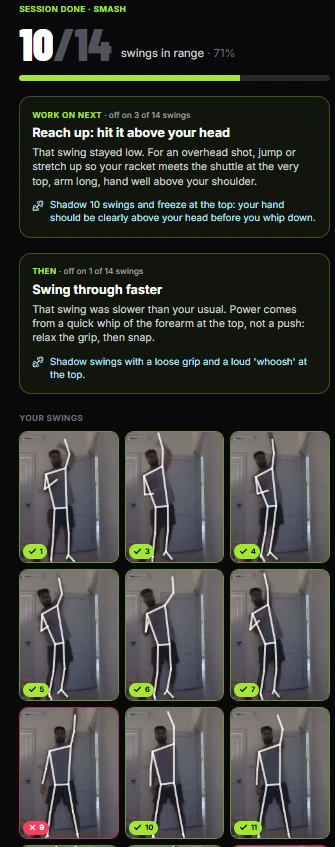
When you finish, you get a report like this one.
- How many swings were in range, out of how many.
- The one thing to work on next, then the next, each with a drill.
- Every swing as a picture with your skeleton on it: ticked, or flagged with what was off.
What you hear and see when you are off
Hitting it too close to you
The coach says: “Meet it further out in front.”
On screen: Meet it further out in front.
Drill: Shadow swings, freezing at contact: your hand should be clearly in front of your shoulder before you swing for real. If the ball is too close, move your feet, not your arm.
Hitting it too high
The coach says: “Let it drop. Meet it lower.”
On screen: Meet it a little lower.
Drill: Shadow swings with your knees bent, freezing at contact at the right height, so your legs do the lowering and your arm stays quiet.
Hitting it too low
The coach says: “Take it a bit higher.”
On screen: Meet it higher.
Drill: Shadow swings freezing at contact at the right height, then feed yourself a ball and take it on the rise.
Too big a backswing
The coach says: “Shorten the backswing.”
On screen: Keep the backswing short.
Drill: Shadow swings with a wall behind you that your racquet may not touch, or with your back against a real wall.
Arm too low
The coach says: “Get that arm up a bit higher.”
On screen: Lift your hitting arm a lot higher at contact.
Drill: Shadow 10 swings in slow motion and freeze at contact: check where your elbow is before you speed up.
Arm too high
The coach says: “Keep that arm a bit lower.”
On screen: Keep your hitting arm a lot lower at contact.
Drill: Shadow 10 swings in slow motion and freeze at contact: check where your elbow is before you speed up.
Arm too bent
The coach says: “Straighten the arm more. Meet it long.”
On screen: Straighten your arm a lot more through contact.
Drill: Slow shadow swings, pausing at contact: your arm should be almost straight with a soft bend.
Arm locked straight
The coach says: “Keep a little bend in the elbow.”
On screen: Keep a lot more bend in your elbow at contact.
Drill: Slow shadow swings, pausing at contact: keep a soft bend and finish with a wrist snap.
Legs too straight in your stance
The coach says: “Bend your knees”
On screen: Bend your knees.
Drill: Hold a low ready stance for 20 seconds between reps.
Hunched over in your stance
The coach says: “Chest up, don't hunch”
On screen: Chest up, don't hunch.
Drill: Hold the ready stance with your chest proud for 20 seconds.
Drills you can do alone
- Shadow volleys: shadow 30 volleys on each side, with a short swing and a step in.
- Racket up drill: from ready, shadow the volley and reset the racket up each time.
How to set up your phone
Prop your phone up 2 to 3 metres away with your whole body in view, at about hip height. For the volley, stand side-on to the camera on your hitting side: how far in front you make contact and how big your backswing is can only be judged from the side. It all runs on your phone and nothing is uploaded.
Guide values: where the hand should be at contact comes from coaching rules (Squash coaching (e.g. Squash Canada): the ball is hit at the top of the bounce, about knee height, slightly ahead of the front shoulder.) and has not yet been checked against real players. Contact point and backswing need you side-on to the camera.
Frequently asked questions
Why volley in squash?
It takes time away from your opponent and keeps you on the T, so you dominate the rally.
How do I volley better?
Racket up early, short swing, step toward the ball and meet it in front.